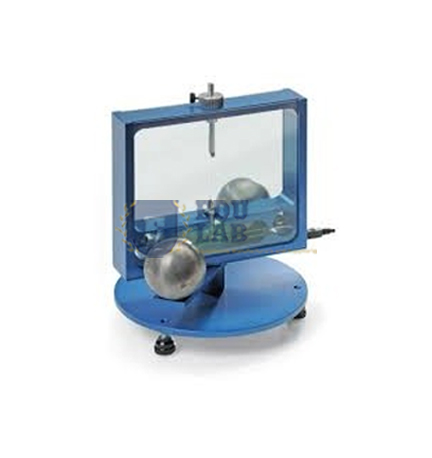
Apparatus for the Study of Harmonic Oscillations Manufacturer,Supplier and Exporter in India
Product Code : EL-TWL-11805
Quick Answer: The Apparatus for the Study of Harmonic Oscillations introduces the harmonic oscillator through a mass hanging from a spring and extends to simple, physical and torsion pendulums. It covers Hooke's law and how period depends on mass, spring constant, length and moment of inertia.
Last updated: October 2026
Key Features
Elastic oscillations of a mass on a spring, and Hooke's law.
Oscillation period against oscillating mass and against spring elasticity constant.
Simple pendulum: period against length, and independence from the oscillating mass.
Physical pendulum: period against moment of inertia.
Torsion pendulum: period against moment of inertia and against the geometric and physical properties of the twisted body.
Study of the motion from an energy viewpoint.
About This Product
Starting with a mass on a spring, students meet a model that explains a great many physical phenomena, then move on to pendulums of increasing complexity. Each experiment isolates one variable, so the dependence of period on mass, stiffness, length or moment of inertia can be measured and compared with theory. The Apparatus for the Study of Harmonic Oscillations can be dispatched from India to Guyana, Saint Lucia, Australia, Zimbabwe, South Korea and Jamaica.
Frequently Asked Questions
What experiments does the apparatus cover?
Elastic oscillations and Hooke's law; simple, physical and torsion pendulums; dependence of period on mass, spring constant and length; independence of period from mass; and an energy-based study of the motion.
What does the torsion pendulum show?
How its period relates to its moment of inertia and to the geometric and physical properties of the twisted body.