Differential Voltage Sensor Manufacturer,Supplier and Exporter in India
Product Code : EL-TWL-11824
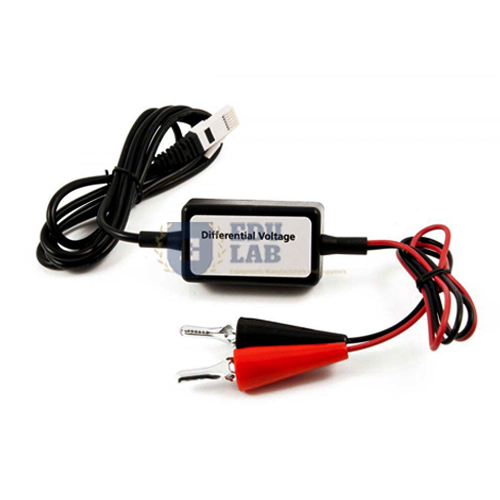
Quick Answer: The Differential Voltage Sensor reads the potential difference between its red and black leads over +/- 6.0 V, with 3.1 mV resolution. Several can be used in one circuit, which makes it the preferred choice for series and parallel circuit work.
Last updated: October 2026
Key Features
Input range +/- 6.0 V, suited to battery and bulb circuits.
Measures between red and black leads.
Several sensors can be used in the same circuit.
Resolution 3.1 mV, linearity 0.01%.
Input impedance to ground 10 megohm; differential impedance over 20 megohm.
Maximum voltage on any input +/- 10 V; supply 5 VDC.
Technical Specifications
Specification
Value
Input voltage range
+/- 6.0 V
Maximum voltage on any input
+/- 10 V
Resolution
3.1 mV
Linearity
0.01%
Input impedance (to ground)
10 megohm
Differential impedance
Over 20 megohm
Supply voltage
5 VDC
About This Product
Students use it to explore the basic principles of electricity, measuring voltages in low-voltage AC and DC circuits. With one sensor across each component, voltages around a series or parallel circuit can be compared at the same time. The Differential Voltage Sensor can be dispatched from India to Burkina Faso, Malaysia, Timor-Leste, United Arab Emirates and Venezuela.
Frequently Asked Questions
Why use a differential sensor in circuit work?
It is the preferred voltage sensor when more than one voltage sensor is used in the same circuit, so several can measure different parts of a series or parallel circuit together.
What voltages can it measure?
Low-voltage AC and DC within +/- 6.0 V; the maximum voltage on any input is +/- 10 V.